


Spanish paperwork... aren't you loving it?
The amount of stamps, staples and copies involved in Spanish administration still manages to surprise me. Even as more and more things become digitalised, somehow I keep finding myself drowning in paperwork, appointments and documents.
And when you've just had a baby, the last thing you want is to spend your first weeks trying to work out what needs to be done, where you need to go and which document you need to take with you.
I know this from experience.
When I registered my own children in Spain, I did the registration process myself. It was easy enough, but at times it was challenging to get the right appointments at the right place and in the right way. Having a valid Cl@ve or digital certificate can make Spanish administration easier (if the websites work, grr), although exactly what you can do online varies depending on the procedure and where you live.
What helped me enormously was a practical list from my gestor, Lourdes Sintas Fernández of Asesoría Sintas. I used her list to work my way through the registration process myself. Because I am autónoma, I also asked Lourdes to handle the application for the parental benefit for both me and my partner.
Lourdes put a lot of effort into helping me navigate the paperwork, and I am very happy to acknowledge her contribution to this guide. She works with both autónomos and companies, is fast and efficient, and speaks English too, something that can make a big difference when you're trying to navigate Spanish administration as an international family.
So I thought I would turn that practical list into a guide for other English-speaking parents having a baby in Spain.
A note before you start: This is a Spain-wide guide, but administrative procedures can vary between municipalities, autonomous communities, hospitals and individual circumstances. The order below is the order that helped me navigate the process, based on the practical guidance I received from Lourdes. Always check the current requirements with the relevant authority.
Newborn paperwork in Spain: the order of things
After your baby is born, there are several different parts of the Spanish administration you may need to deal with.
The order covered in this guide is:
- Hospital or birth documentation
- Doctor / medical paperwork relating to parental leave
- Registro Civil
- Mother's employer, if employed
- Father's/other parent's employer, if employed
- Seguridad Social / INSS
- Empadronamiento
- Centro de salud
- Other paperwork, including private insurance and your baby's nationality and passport
This is the order that helped me make sense of everything — so let's go through it step by step.
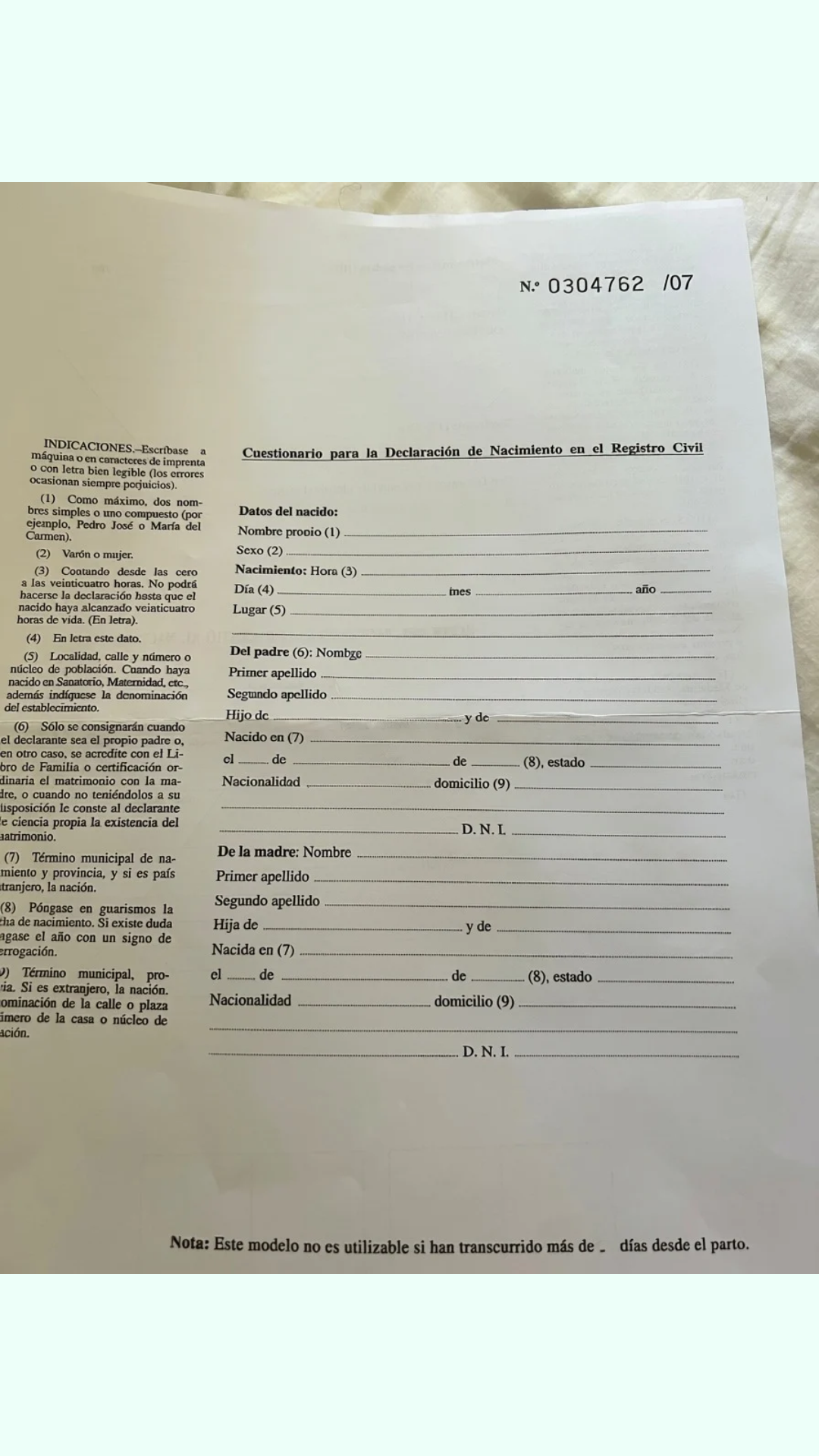
1. Start with the birth documentation
The first piece of paperwork you'll need is the documentation confirming the birth.
Exactly how this works depends partly on where your baby is born.
In some hospitals, the healthcare centre can send the birth declaration electronically to the Registro Civil. The Spanish Ministry of Justice says participating healthcare centres can send the declaration within 72 hours of the birth. (Ministry of Justice)
If the healthcare centre does not communicate the birth electronically, the parents or other people legally responsible for promoting the registration generally have 10 days to declare the birth at the Registro Civil. This period can be extended to 30 days if there is just cause. (Spanish Government — Birth registration)
Photo of the document the midwife or doctor gives you
If your baby was born outside a hospital, the process can be different.
When you have a home birth, where you get this document from depends on who attends the birth. If you plan your home birth with an official home birth midwife, she provides the paperwork. If you're planning an unassisted birth or a birth with a partera, you'll need to get the document from a doctor who is willing to work with you.
In my case, this looked different each time: a midwife provided the documentation for my first Spanish birth (my second child), and a doctor for my second Spanish birth (my third), since I used a Partera that time.
One tip: Keep every original document you receive. I would also recommend making digital copies of important documents and keeping them somewhere safe.
You may need the birth documentation several times during the weeks following your baby's birth.
A useful distinction
You may hear several different terms used when talking about birth documentation:
- documento de nacimiento
- declaración de nacimiento
- certificado de nacimiento
- certificado literal de nacimiento
They are not necessarily all the same document.
The Registro Civil registration is the official registration of the birth. Once the birth has been registered, you can obtain official certification from the Civil Registry.
This distinction can become particularly important when you are dealing with your own country's embassy or consulate, because they may ask for a specific type of Spanish birth documentation.
2. Deal with the medical paperwork for parental leave
If you or your partner are going to claim the Spanish benefit associated with the birth and care of a child, there is another part of the process involving your medical and employment situation.
The terminology you will encounter today is prestación por nacimiento y cuidado de menor, the benefit for birth and care of a child.
In Lourdes's practical list, the next step is to take the birth documentation to your médico de cabecera and obtain the relevant medical paperwork for the leave.
This is one of those moments when knowing the Spanish terminology helps enormously. If you're looking for information online, don't only search for "maternity leave Spain" or "paternity leave Spain".
Search for:
prestación por nacimiento y cuidado de menor
The current Social Security system covers workers who have had or are going to have a child through birth, adoption or other qualifying circumstances, subject to the applicable requirements. (Spanish Social Security, Prestación por nacimiento, adopción y cuidado de menores)
3. Register your baby with the Registro Civil
This is the big one: your baby's birth registration.
The Registro Civil is the Spanish Civil Registry, where the official registration of the birth is made.
In my case, I registered my children myself. Having Lourdes's list meant I knew what I needed to do next instead of trying to figure out the entire system from scratch.
The exact process can vary depending on where and how your baby was born.
As mentioned above, some hospitals can transmit the birth declaration electronically. If that applies to your birth, you may not need to make the same journey that I did. (Ministry of Justice — Birth registration)
If you do need to register the birth yourself, check:
- which Registro Civil is responsible
- whether you need an appointment
- whether the appointment needs to be booked online
- which documents they require
- whether both parents need to attend
And remember the general deadline: 10 days, extendable to 30 days for just cause, when the birth has not already been communicated by the healthcare centre. (Spanish Government — Birth registration)
What about the Libro de Familia?
This is another area where things can be confusing for expat parents.
Spain used to issue the traditional Libro de Familia, a physical family book in which births, marriages and other family events were recorded.
I received one when my Spain-born daughter was registered. Interestingly, my older daughter, who was born in the Netherlands, wasn't included in that book.
By the time my youngest was born, the system had changed and Libro de Familia was not used anymore. Although I've also heard from families who did receive one because the office still had some lying around and didn't want to spoil them. Haha, Spain, aren't you loving it?!
So don't panic if you don't receive the traditional little family book that you may have heard about.
4. If the mother is employed: deal with her employer
If the mother works cuenta ajena, in other words, she is employed by a company, there is an additional employment-related step.
Lourdes's checklist includes giving the relevant leave documentation to the employer and requesting the certificado de empresa needed for the Social Security benefit.
If you are autónoma, this employer step does not apply to you.
This distinction is particularly important for expat families because you may have one parent who is employed by a Spanish company and another who is self-employed.
Don't assume that both parents follow exactly the same administrative route.
5. If the father or other parent is employed: deal with their employer
The same applies to the father or other employed parent.
If they are cuenta ajena, they may need to provide their employer with the relevant documentation and request the certificado de empresa for the Social Security application.
Again, this step does not apply in the same way to an autónomo.
The current Spanish system refers to the benefit as prestación por nacimiento y cuidado de menor, rather than separate "maternity" and "paternity" benefits. Spanish Social Security, Prestación por nacimiento, adopción y cuidado de menores
6. Apply for the Social Security benefit: INSS
Now we get to the part many new parents are particularly interested in:
getting the parental benefit paid.
The application is made through the Instituto Nacional de la Seguridad Social (INSS) for the prestación por nacimiento y cuidado de menor.
The Social Security provides online routes for the application, including access through digital identification, as well as routes for people who do not have a digital certificate or Cl@ve. Spanish Social Security, Birth and childcare benefit
In my own case, Lourdes handled this application for me and my partner, which was one less thing for me to deal with during those first weeks with a newborn.
Registering your baby for healthcare through Social Security
At this stage, you also need to make sure your baby is covered under the appropriate healthcare entitlement.
The Social Security specifically states that if your new child is under three months old, you can register them as your beneficiary for healthcare. This can be done through the Social Security's online services if you have a digital certificate, DNI electrónico or Cl@ve, or through a CAISS office if you don't. Spanish Social Security, Registering a newborn as a healthcare beneficiary
There is also a useful practical point here: the Social Security explains that, when the child is under three months old, the birth documentation may not need to be presented because it will generally already have been transmitted by the Registro Civil. Spanish Social Security, How to request the birth and childcare benefit
Once this part is completed, you can move on to the health centre.
7. Empadronamiento: register your baby at your address
Next comes the empadronamiento.
The padrón municipal is the municipal register of people living at an address.
You need to register your baby at the family address with the relevant Ayuntamiento or local office. Exactly where and how you do this varies between municipalities, so check your local town hall's requirements.
In Lourdes's list, the documents included:
- identification documents
- family documentation where applicable
- documentation relating to the baby's registration
The municipality will provide you with the relevant padrón documentation that you can then use for the next stage.
This is one of the reasons I recommend keeping a folder, physical and digital, with every document you receive.
Spanish administration has a habit of asking you for a document you remember receiving three steps earlier.
8. Register your baby at the health centre and choose a paediatrician
Once your baby has been registered for healthcare through Social Security and you have the relevant padrón documentation, you can register your baby with your local centro de salud.
The Social Security explains that after registering the newborn as a healthcare beneficiary, the next step is to request the child's health card through the health service of the relevant autonomous community, where the child will be assigned a paediatrician. Spanish Social Security, Birth and childcare benefit / healthcare
You may be asked for documents such as:
- your identification
- your baby's birth or family documentation
- confirmation of healthcare entitlement
- proof of empadronamiento
The exact paperwork can vary because healthcare administration is managed regionally.
The general sequence is useful to understand:
Social Security → padrón → health centre → paediatrician
That way, if someone tells you "you need to register your baby at the health centre," you know which steps normally come before it.
9. Don't forget the other paperwork
Once you've made it through the main Spanish administrative steps, there are still a few things that may be relevant, especially for international families.
Does my baby automatically get Spanish nationality?
No, not simply because they were born in Spain.
If two foreign parents have a baby in Spain, the baby does not automatically become Spanish simply because of their place of birth.
There are specific exceptions under Spanish nationality law. For example, certain children born in Spain to foreign parents can be Spanish from birth if both parents are stateless or if neither parent's law gives the child a nationality. Spanish Civil Code — Article 17
For many children of foreign parents, however, the baby's nationality will come through one or both parents according to their own country's nationality law.
There is also an important point for families living in Spain: a person born in Spanish territory can qualify for the reduced one-year legal-residence period for an application for Spanish nationality by residence, provided the legal requirements are met. This does not mean that Spanish nationality is automatically granted after one year. An application still has to be made and the requirements fulfilled. Spanish Civil Code — Article 22
If this is something you are considering for your child, check the current requirements before making any decisions.
Does my newborn need an NIE?
This is another question many international parents have.
A baby born in Spain does not automatically receive an NIE simply because they are born here.
The NIE — Número de Identidad de Extranjero — is an identification number for foreign nationals who have an economic, professional, social or other relevant relationship with Spain. It is assigned when the relevant requirements are met. Spanish Ministry of Interior, NIE
So birth registration and an NIE are two different things.
In fact, my youngest still doesn't have an NIE. We went through the process of trying to register her, but there was an administrative problem and, two years later, we still need to return to sort it out.
Yes... Spanish paperwork.
If your baby needs an NIE for a particular reason, check the specific requirements for your situation rather than assuming it is automatically part of the newborn registration process.
Your baby's passport and nationality: don't leave this until the last minute
This is especially important if you are an international family.
Your baby being registered in the Spanish Registro Civil does not automatically give them a Spanish passport.
If your baby has another nationality, you will generally need to deal with your own country's authorities to register the birth according to their requirements and obtain your baby's passport or other travel document.
The process can vary enormously between countries.
I know from parents with US passports, for example, that the paperwork involved in registering a baby born in Spain and obtaining a US passport can be considerably more involved than for some other nationalities.
So if you know you will need to travel, contact your embassy or consulate early and ask exactly what they require.
The same applies if you do not live in Spain but your baby is born here. You may need Spanish birth documentation when registering the birth with your own country and applying for your baby's passport.
Your nationality or country of citizenship matters here, so don't rely solely on a general Spain-wide checklist.
A note about an alternative route some international parents investigate
You may also come across discussions among international parents about using natural law as a possible route to obtaining a passport without first obtaining the standard Spanish birth certificate, using the initial birth documentation issued by a doctor, midwife or hospital instead.
I want to be very clear about this because I did not choose this route myself and I do not have enough information or personal experience to explain or recommend it.
I am mentioning it because I know some parents actively investigate this possibility, and if you are one of them, you may want to research it further rather than assuming it is irrelevant simply because it is not part of the standard process described above.
If you are considering this route, I would recommend getting specific advice from an appropriately qualified legal professional or parents that are in the exact same situation and went through the process successfully.
One practical issue to keep in mind when giving birth in a hospital and wanting to go this route is that you have to make sure the hospital doesn't submit the paperwork for the Spanish Registro Civil automatically. Otherwise your baby is registered anyway. The healthcare centre can submit the declaration within 72 hours of the birth. Spanish Ministry of Justice, Birth registration
This is not a route I used for my own children, and I am not presenting it as legal advice or recommending it. I simply want to flag that it is something some international parents ask about, so that those who are specifically researching it know to investigate it further.
Don't forget private health insurance
If you have private health insurance in Spain and want to add your baby to the policy, contact your insurer as soon as possible after the birth.
Ask the insurance company:
- what documents they need
- how long you have to add the baby
- from what date the baby's cover will be effective
- whether there are any waiting periods or special conditions
Don't assume that your baby's cover is automatically identical to yours.
Every insurer has its own rules, so check directly with your provider.
My biggest tip: keep everything together
If I could give one practical piece of advice to a new parent dealing with Spanish administration, it would be this:
Create one newborn paperwork folder before you start.
Keep both the originals and digital copies of:
- birth documentation
- Registro Civil documents
- Social Security documents
- padrón documents
- healthcare documents
- parental benefit documents
- passport and nationality paperwork
- insurance documents
- appointment confirmations
- applications and receipts
And whenever you submit something online, save the confirmation.
If you are using Cl@ve or a digital certificate, make sure you can actually access it before the baby arrives. Spanish administration is easier when you can complete a procedure from your sofa instead of trying to find an appointment while holding a newborn. If the site doesn't seem to work, try again later. It can help to try different times and keep trying, Spanish websites, also the websites of the government, don ´t always work as smooth as one would expect.
You don't have to figure it all out at once
When you're pregnant, people often tell you about the hospital bag, the birth plan and what to buy for the baby.
Much less often does anyone tell you:
"By the way, after the baby arrives, you'll have a whole new administrative adventure."
I remember finding the paperwork manageable once I knew what I was supposed to do. The difficult part was knowing what came next.
That is exactly why Lourdes's list was so useful to me.
You don't necessarily need someone to do everything for you. Sometimes you just need someone who can help you understand the system, put the steps in the right order and tell you which piece of paper belongs where.
And if you are doing it yourself, I hope this guide saves you some of the confusion and perhaps a few unnecessary trips out of the house with a newborn.
Want the checklist without having to reread the article?
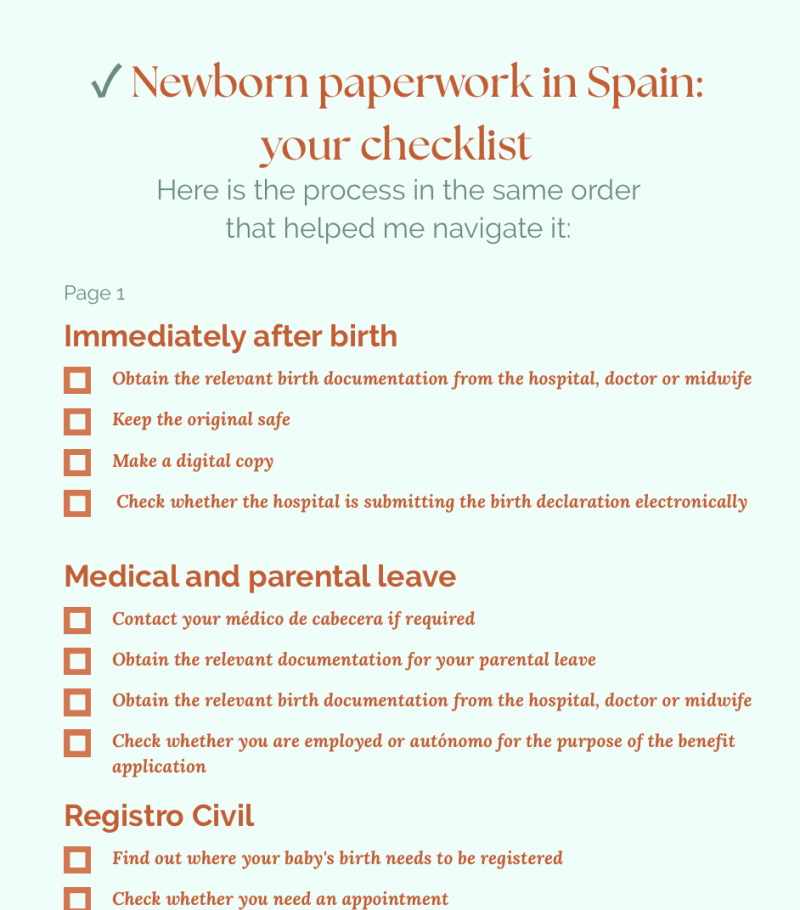
This is where our journey begins. Get to know our business and what we do, and how we're committed to quality and great service. Join us as we grow and succeed together. We're glad you're here to be a part of our story.
Important disclaimer
This guide is intended for general information and practical orientation only. It is based on my own experience, practical guidance I received from Lourdes Sintas Fernández of Asesoría Sintas, and information from Spanish public authorities.
Requirements and procedures can vary depending on your municipality, autonomous community, nationality, employment situation, family circumstances and how and where your baby was born. Administrative procedures can also change.
Always check the current requirements with the relevant Spanish authority and, for nationality and passport matters, with your own embassy or consulate. This article is not legal, immigration or tax advice.
Want to delve into the material yourself? Good idea! Here are my sources
Spanish Ministry of Justice, Birth registration
Spanish Government, Birth registration in the Spanish Civil Registry
Spanish Social Security, Prestación por nacimiento, adopción y cuidado de menores
Spanish Social Security, Registering a newborn as a healthcare beneficiary
Spanish Social Security, How to request the birth and childcare benefit
These pregnancy & birth blog stories you might also like:

Add comment
Comments