

Giving birth in Spain as an expat? Know your legal rights — consent, refusing interventions, privacy, choice & home birth — explained in plain English.
When I was pregnant with my third baby, I visited a few hospitals to get a feel for them. At one of them, on the tour, I started asking the "difficult" questions — the ones about choices and consent. The maternity nurse showing me around told me, quite simply, that the doctor decides, not the patient.
I gently pushed back. I explained that I'm the patient, that I have human rights, that nothing happens without my consent — and that hospital protocol, however useful, isn't law. Her reply has stayed with me ever since: "Well… here, you should see it as law. It's the law, and the doctor decides."
I was blown away. And I knew immediately I wouldn't be having my baby there — not because of that one nurse, but because of what her answer quietly revealed about the culture of the whole place. Because the culture of a hospital is exactly what surrounds you on the day you give birth.
So let's start there, with the thing she got wrong: you'll often hear "it's hospital protocol." Protocols are guidelines for the staff — NOT law! They never override your right to accept, refuse, or choose an alternative. A protocol describes the default. You're allowed to be the exception.
And here's something that surprises most people: a protocol being "standard" doesn't mean it's backed by strong proof. When researchers actually examined the evidence behind maternity guidelines, they found that only around 8–13% rest on the highest-quality evidence (large randomised trials or systematic reviews). Roughly 40% come down to expert opinion or consensus — essentially "this is how we've always done it" — and the rest rely on lower-quality or observational evidence. As midwifery researcher Dr Sara Wickham puts it, almost ninety per cent of maternity care recommendations are not based on good-quality evidence.
That's not a reason to distrust your care team — protocols exist for a reason. But it is a reason to feel entitled to ask questions, and to know that "it's protocol" is the start of a conversation, not the end of one.
You deserve to be somewhere that sees you as the decision-maker — not somewhere you have to fight to be heard.
Know Your Rights: Giving Birth in Spain as an Expat
Let's be honest. Walking into a Spanish hospital to have your baby — in a language that isn't fully your own, in a system you didn't grow up with — can feel daunting. You find yourself wondering: "Am I allowed to ask for that? Can I say no? Will anyone actually listen to me?"
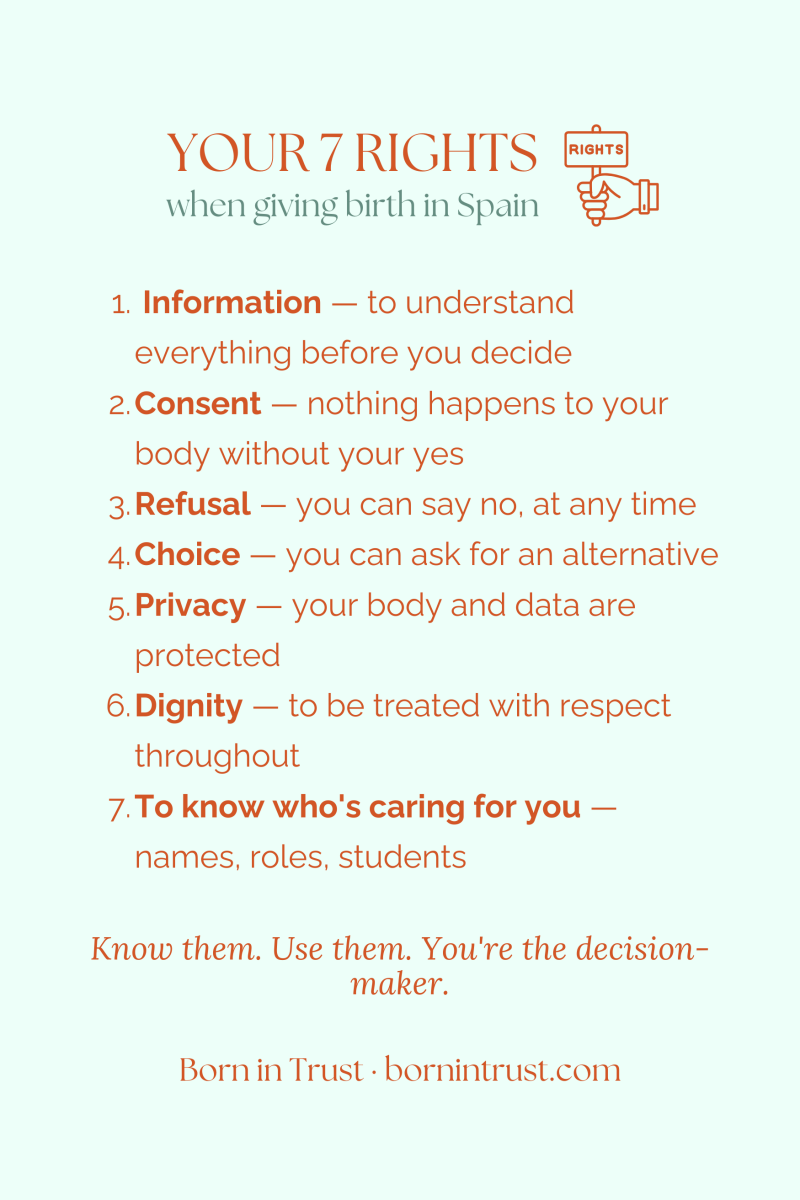
Here's something that changes everything: you have rights, and they are written into Spanish law. Not vague preferences you have to beg for — real, legal protections covering your body, your dignity, your privacy and your choices. They apply whether you're in a glossy private clinic in Madrid or a busy public hospital in Valencia.
Knowing them does three powerful things. It softens your fears, it helps you advocate for yourself and your baby, and it reminds everyone in the room that birth happens with you, never to you.
So let's walk through what you're entitled to — in plain English.

First, the foundation: Spanish law is on your side
Your rights as a birthing woman in Spain are protected by Ley 41/2002 (the Patient Autonomy Law), backed up by the Oviedo Convention and the Ley 44/2003 on health professions. These aren't suggestions. They're the legal backbone of every interaction you'll have with a midwife or doctor here.
And one reassuring point before we dive in: your rights are identical in the public and private systems. In a private hospital you usually choose your own OB; in the public system you're assigned a team. But the law protecting your consent, privacy and choices doesn't change between the two.
1. Your right to information
Anything that's going to happen to your body, you have the right to understand first — truthfully, and explained in a way that genuinely makes sense to you. That means knowing the purpose, the nature, the risks and the consequences of any procedure before it takes place.
💡 In the room: Never feel awkward asking "Can you explain why?" or "What are my options here?" Every professional caring for you is legally responsible for informing you. And if you'd rather not hear certain details — that's your right too.
2. Your right to consent — nothing happens without your "yes"
As a rule, nothing should be done to you without your consent. This is the heart of it all: it's your body, so it's your decision. For surgery and invasive procedures, that consent must be in writing — and you can withdraw it at any moment, even after you've already agreed.
During labour you may feel vulnerable and find it hard to put your wishes into words. A good care team works harder in that moment to make sure you understand and truly agree — not less.
💡 This is exactly why we prepare your preferences long before the big day — so your voice stays clear even when you're deep in your birthing zone.
3. Your right to say no — refusing interventions during labour in Spain
Consent isn't worth much if you can't also say no. You have the legal right to refuse any treatment or intervention. And refusing one option doesn't mean you'll be shown the door — when alternatives exist, you can't be forcibly discharged for declining. Your refusal is simply recorded in writing.
4. Your right to choose — epidural, monitoring and birth positions

You get to decide freely between the available clinical options:
- The position you birth in
- Continuous or intermittent monitoring
- Moving around freely or staying in bed
- An epidural, or staying with breathing and comfort techniques
- Constant emotional support during labour
Your providers are obliged not only to do their job well, but to respect your decisions without moralising or pressuring you. The only real limits are whether an option is genuinely available at your hospital, and good clinical practice.
💡 Which options are on offer varies by hospital — a brilliant question for your hospital tour or birth plan meeting.
5. Your right to privacy
Think about it: birth is an intimate, even sexual event, and most interventions happen on the most private part of your body. So your privacy deserves extra protection here, not less — both physical privacy and the confidentiality of your medical records. No one may access your data without authorisation, and any intrusion on your body should be the minimum genuinely needed to care for you and your baby.
6. Your right to dignity — and to refuse being a "teaching case"
You are a person, never a practice dummy. This is enshrined in the Oviedo Convention:

In a teaching hospital, this matters enormously. Examinations, procedures, or the presence of students purely for training purposes require your prior, informed permission. A "practice" vaginal exam, or a "teaching" use of forceps with no medical reason behind it, needs your explicit yes. Being in a university hospital does not cancel your rights.
💡 You're allowed to ask: "Is this medically necessary right now, or for training?" — and to decline having students present.
7. Your right to know who's caring for you
You can ask any professional their name, role, qualification and specialty, and they're legally required to be identifiable to you. On a busy ward with faces coming and going, you're entitled to know exactly who is doing what.
So what do you do with all this?
Knowing your rights is step one. Feeling calm and confident enough to actually use them, in Spanish, in the moment — that's the real work, and it's exactly what we do together.
- Grab my free Birth Plan Pack to start mapping out your wishes. You'll get a sample letter for your hospital, an extensive list of choices you can make in pregnancy, birth and postpartum and a birth preference sheet to fill in yourself with an example. everything in English and Spanish so it´s easier for you to write your Spanish Birth Plan.
- Book a 1:1 Birth Plan Meeting. In this meeting both you and your birth partner will gain comprehensive insights into the choices available, how to make a choice and where to find extra information on the things important to you, ensuring your birth plan perfectly aligns with your values and preferences.
- Or go all in with my HypnoBirthing Course and learn to navigate the Spanish maternity system with real confidence.
You don't get a do-over for this birth. Let's make sure it's one you look back on with a smile. 🧡

Is home birth legal in Spain?
This works quite differently from countries like the UK or the Netherlands, so here are the essentials (I'll cover home birth in much more depth in a separate post).
Yes, home birth is legal in Spain — the WHO recognises it as a valid option for low-risk pregnancies. A few practical realities to know:
- It isn't covered by the public health system, so you'll need to hire and pay for a private, independent midwife.
- Availability is patchy — midwives are concentrated around Madrid and Catalonia, and only about 0.3% of births in Spain happen at home.
- There's no single, standardised transfer protocol like the Dutch one. In practice, if your midwife feels a transfer is needed, you go to the emergency department of your chosen back-up hospital, where their team takes over — sometimes alongside your midwife, sometimes not. It's workable; it just means choosing your back-up hospital in advance matters.
Home birth is generally recommended only when WHO safety criteria are met: a low-risk, single pregnancy, no previous caesarean, and birth at roughly 37–42 weeks. But it's worth being clear: these are clinical safety recommendations, not legal rules. Birthing at home outside them isn't illegal — it just means your pregnancy is no longer considered low-risk, and in practice many midwives won't attend a birth that falls outside their safety and insurance guidelines.
💡 Your rights to information, consent and dignity apply just as fully at home as in hospital — and the Birth Plan Pack includes a home birth version of every template.
Frequent Asked Questions about women's rights during birth in Spain
This article explains rights protected under Spanish health law, including Ley 41/2002 (Patient Autonomy), the Oviedo Convention (1997) and Ley 44/2003. It draws on the legal framework set out by lawyer Francisca Fernández Guillén for El Parto Es Nuestro This is general information, not legal or medical advice — and I, Titia van der Waal, am not a legal or medical professional.
Want to delve into the material yourself? Good idea! Here are my sources
These pregnancy, birth and postpartum blog stories you might also like:



Add comment
Comments