


Choosing where to give birth in Spain is about more than whether maternity care is public or private. This guide compares intervention rates, birth philosophy, costs and your options, helping you make an informed decision that fits your own priorities.
Public C-section rate
22.4%
Private C-section rate
34.5%
WHO recommended
10-15%
Sources: Ministerio de Sanidad (2024). Informe SNS 2023 [1] and World Health Organization (1985/2015). WHO Statement on Caesarean Section Rates. [2]
- Private hospitals have a much higher C-section rate, 34.5% vs. 22.4% in public hospitals, more than double the WHO's recommended 10-15%.
- "Your own doctor" isn't guaranteed, even privately. Many private obstetricians also work in the public system or rotate shifts, so continuity of care is often less certain than it's marketed to be.
- Choosing where to give birth matters less than choosing how. The real difference is a hospital's model of care, active management, standardised, or physiological, not simply its public or private status.
- Public care is publicly funded, not free. There's no separate bill at the point of care, but it's paid for through taxes and social security.
- A private birth typically costs €6,000-10,000+, a planned home birth €1,300-5,000, both can be paid out of pocket, but only the private clinic can also be covered by your private insurance depending on the contract between your insurance company and the clinic.
- Private insurance has a waiting period (carencia), typically 6-9 months, so cover needs to be arranged before conception, not after a positive test.
- You have a legal right to choose your hospital and obstetrician in the public system, though how well that right works in practice depends heavily on your region.
- Public hospitals face high patient volume and a doctor-led culture, which can make care feel rushed, but private care's added "choice" is mostly logistical, not more say in your actual treatment.
- The real question isn't public vs. private. It's whether the specific hospital and specific obstetrician support the kind of birth you want.
Public vs Private birth in Spain: What’s the difference?
The reasons people choose private are usually the same: your own doctor, not whoever’s on shift. A private room. Often a proper bed, or at least a good couch, for your partner, and in some private hospitals your partner can even stay overnight with you and the baby after birth, something that’s much rarer in the public system. Many private hospitals also throw in hotel-style extras: gowns, socks, large maternity pads, breastfeeding support items, nappies, baby clothes, wipes, meals for your partner. All fair things to want, especially when you’re navigating a new country and a new language on top of everything else.
But here’s what nobody tells you before you sign up: private care in Spain comes with a higher chance of ending up with a C-section, an induction, or an instrumental delivery, not because your pregnancy is riskier, but because of how the system is built. Public hospitals actually handle the higher-risk births, since they’re the ones equipped for genuine emergencies and complex pregnancies.
So before you decide based on comfort and continuity, it’s worth understanding what you might be trading away.
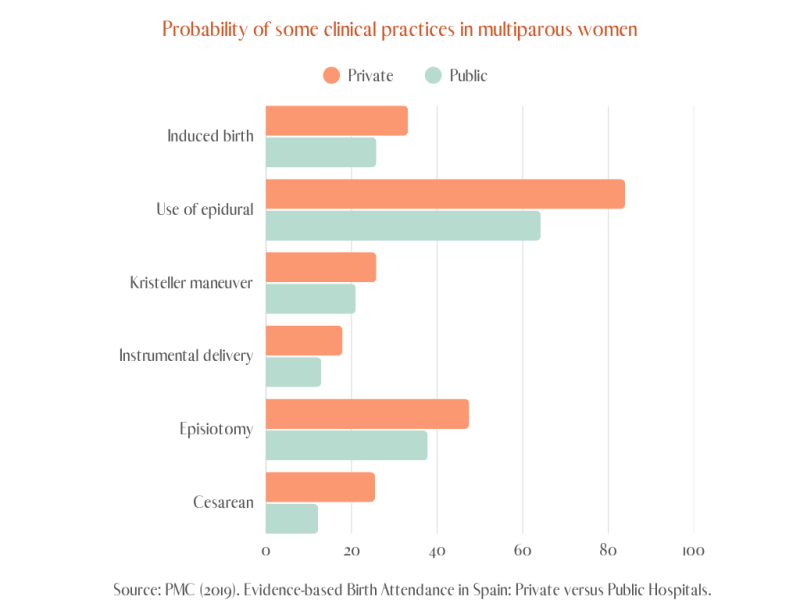
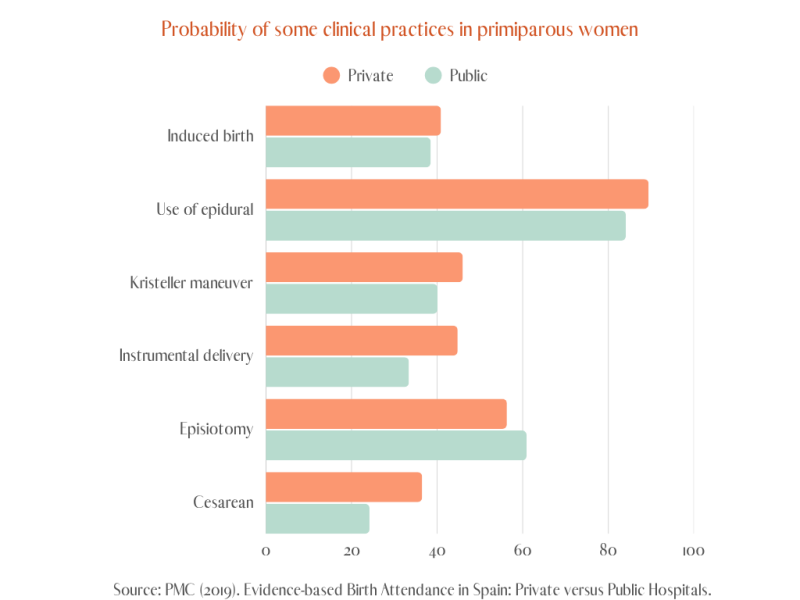
One Spanish study found that, even after accounting for the differences between women, those giving birth in private hospitals had more medical interventions than those in public hospitals.[3] First-time mothers were more likely to have an epidural, an instrumental birth, or a C-section. Women who’d given birth before were more likely to have labour induced, receive an epidural, and give birth by C-section, while being less likely to use natural pain relief.


Why Are C-Section Rates Higher in Private Hospitals in Spain?
Let’s start with the numbers.In public hospitals, 22.4% of births end in a C-section. In private hospitals, it’s 34.5%.[1]
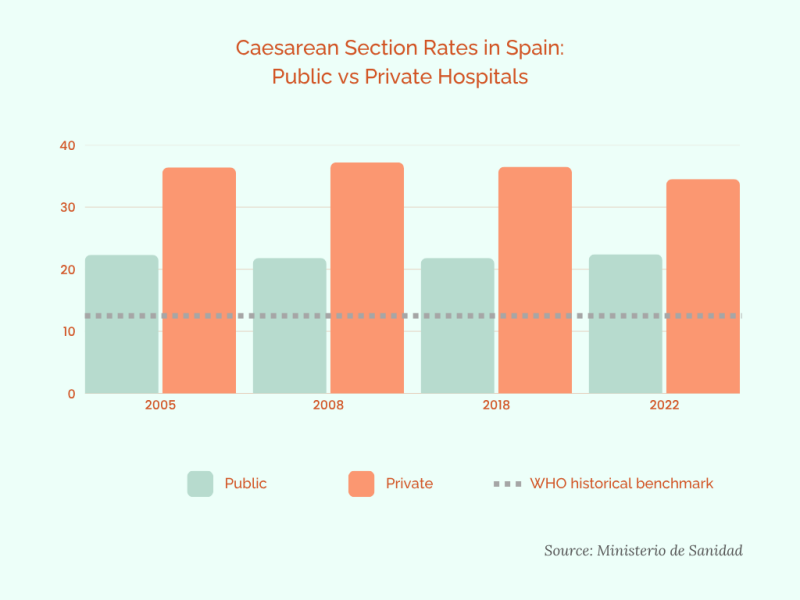
Since 1985, the World Health Organization has said that C-section rates above roughly 10 to 15% bring no further reduction in maternal or newborn mortality.[2] More intervention doesn’t mean safer care. For women with uncomplicated pregnancies, the evidence doesn’t support that assumption, but it does fundamentally change how birth unfolds.
Midwives barely feature in many private hospitals. It’s the obstetrician who follows your pregnancy and who’s expected to attend the birth, and an obstetrician’s heavier hands-on involvement in labour is linked to higher intervention rates, C-sections included.
Here’s how I put it in my courses: if you want your teeth cleaned, you go to a dental hygienist, not an oral surgeon. If you don’t want surgery, you don’t book yourself in with a surgeon. And if you want a natural birth, you need a specialist in natural birth, which, however skilled they are, is not what your obstetrician/gynecologist is trained for.
They’re trained to intervene. That’s their job, and it’s a valuable one when something actually goes wrong. But it also shapes how they see a normal, straightforward labour.
Which brings us to the promise that draws a lot of people to private care in the first place: your own doctor will be there. In practice, that’s often less certain than it sounds. Many private obstetricians also work in the public system, don’t cover night shifts themselves, or are part of a rotating team, so the doctor you’ve built a relationship with over your pregnancy may not be the one who shows up on the night you go into labour.
There’s a language version of this same issue too. For a lot of expats, one real reason to choose private is that your obstetrician speaks English. Fair enough, but during the birth itself you’ll be spending far more hands-on time with the midwives on duty than with your obstetrician, who typically appears for the delivery itself and not much else. If English-language communication is your actual reason for choosing a hospital, it’s worth checking that it holds up where it counts: ask specifically whether the midwives speak English, not just your consultant.
That uncertainty creates its own pressure. If a clinic wants to guarantee a specific doctor’s presence, the easiest way to do it is to schedule you: an induction or a planned C-section on a day and time that suits their calendar. It isn’t always presented that way. Sometimes a medical reason is given that doesn’t really hold up, when the real driver is convenience. There’s a financial logic underneath it too: a C-section is faster and easier to plan around than a vaginal birth, which can take however long it takes.
I’ll also say this: some women are genuinely happy with an induction, an assisted delivery, or a C-section that isn’t medically necessary. They choose private care for the food, the private room, the sea view, or simply because those things make them feel more comfortable. That’s a completely valid choice if it matches your priorities.
But if you’re reading this, and you’re drawn to what I teach about informed choice and physiological birth, I’m guessing that’s not you.
What Does Giving Birth in Spain Actually Cost?

Public Hospital
Free · lower intervention rates

Private Hospital

Home Birth
€1,300-3,000+ · lowest intervention
€6,000-10,000+ · comfort
Under the public system in Spain, maternity care in pregnancy and birth is ¨ free ¨ (paid for through the taxes and social security contributions). Prenatal checks, standard scans, bloodwork, the birth itself, and postnatal follow-up are all covered once you’re enrolled in the Sistema Nacional de Salud (SNS), no separate bill, whatever kind of delivery you end up having.
Private care is a different story, and the range is wide. A full private pregnancy, monitoring plus delivery, typically runs somewhere between €6,000 and €10,000 if you’re paying out of pocket, more for a C-section, complications, or a higher-end clinic with an individual suite, where the total can climb well past €12,000.[15] If you carry private insurance with maternity cover, monthly premiums typically run €50 to €120, depending on the insurer, your age, and what’s included.[15]
Worth noting: even within the private market, a C-section costs more than a vaginal birth. The financial incentive toward more intervention isn’t just a public-versus-private issue, it shows up in the pricing itself.
A planned home birth with an independent midwife sits in its own price bracket. It typically runs €1,300 to €3,000, though some 2025 reporting puts the upper end closer to €3,000-5,000, depending on what’s included: prenatal visits, postpartum care, equipment, a second midwife, and so on.[18] Since home birth isn’t publicly funded in Spain, it’s paid entirely out of pocket. The final figure also depends on how many midwives attend (some work in pairs for a second pair of hands, particularly for a first birth), how many prenatal and postpartum visits are included, and whether the midwife needs to travel a distance to reach you, since many independent midwives charge separately for travel or accommodation if you live far from them.[19]
Insurance, visas and the maternity waiting period
Here's something that catches a lot of expats off guard: Spanish private health insurers apply a carencia, a waiting period, before maternity cover kicks in. It's typically 6 to 9 months, and there's no standard policy that waives it; a small number of premium policies offer a zero-carencia option, usually at a significantly higher price.[15] In practice, that means taking out insurance after you're already pregnant usually won't cover that pregnancy's birth at all. If you want to have your baby in Spain, it's worth locking in cover well before you conceive, not after a positive test.
The catch is that most people don't know which type of care they'll actually want, private, public, or a home birth, until they're further along in the pregnancy. Still, it's worth thinking through the possibilities before you conceive, since the insurance decision has to be made earlier than the birth decision does. A few common paths:
- Fully private care, paid entirely out of pocket
- A hybrid: private tests and antenatal appointments, with the birth itself at a public hospital
- Private care throughout, at a private hospital your insurer has contracted with
- A birth centre or home birth, which is almost always paid out of pocket regardless of insurance
A few situations worth knowing about depending on where you stand:
-
EU/EEA visitors on an EHIC, or UK residents on a GHIC: your card covers medically necessary care for an unplanned birth or pregnancy complication at any public hospital, the same as any other emergency. It does not cover a planned birth, since the assumption behind the card is that you’ll return home for that.[16] I've worked with families travelling through Europe who wanted to give birth in Spain: they saw a Spanish doctor late in pregnancy for a declaration stating they were no longer fit to travel, and used that note to get their home-country insurer to approve the birth taking place in Spain instead.
-
Non-EU residents without a route into Social Security yet: the convenio especial lets you buy into the SNS directly, but it requires a full year of continuous prior residency and empadronamiento, which puts it out of reach if you’ve only just arrived and are already pregnant.[17]
-
Non-Lucrative Visa and Digital Nomad Visa holders: both visas require comprehensive private insurance with no copays or coverage caps as a condition of the visa itself, so you likely already have qualifying cover, just confirm it doesn’t carry a maternity exclusion that would leave you exposed.[17]
All of this applies if you want to make use of the maternity system in Spain in some way, whether that's public, private, or a mix. If that's the route you're considering, it's worth confirming the specifics directly with your centro de salud, your insurer, or an immigration advisor, since the rules depend on your specific visa, contribution history and region. Some families choose to go without formal antenatal care entirely, and that's a valid choice too, but if you do want to engage with the system, it's better to know where you stand well before labour starts than to find out mid-pregnancy.
The Most Important Question Isn’t Public or Private, It’s the Model of Care
Many parents think choosing where to give birth in Spain comes down to a simple choice: public hospital, or private hospital.
That’s only part of the story. The more important question is: what model of labour does this hospital actually practise?
In my HypnoBirthing course, I explain four different models of care. Most hospitals in Spain fall somewhere between the first two.
Obstetric care is designed to recognise and treat complications. Physiological maternity care is designed to support the normal biological process unless there’s a genuine medical reason to intervene. These are complementary approaches, but they are not the same model of care.
Active Management of Labour
Birth is largely managed by healthcare professionals, with relatively little input from parents. Labour is expected to progress according to hospital protocols and timelines, and interventions are commonly used to keep it moving.
Standardised Labour
Many hospitals now describe themselves as supporting physiological birth, and compared to twenty years ago, that’s true in some ways. Birth plans are becoming more widely accepted. But many hospital birth plan templates, including those from hospitals and regional health authorities, mostly let parents choose between options that already fit existing hospital protocols and timelines. They rarely offer real room to request care outside those established pathways.
Some interventions are no longer routine, water birth is becoming more available, parents often have more choices. These are genuine improvements. But for parents who want a truly physiological birth, this model is still fundamentally different from one. Labour is still expected to fit hospital systems and timelines, rather than the system adapting to the physiology of birth itself.
Physiological Labour
Here, labour is understood as a normal biological process unless there’s a genuine medical reason to intervene. The emphasis shifts from managing labour to supporting it:
-
Parents play an active role in decision-making
-
Movement is encouraged
-
Food and drink are usually allowed
-
The body’s own urge to push is respected
-
Delayed or optimal cord clamping is routine
-
Interventions are only introduced when medically indicated
Some hospital midwives work as closely as possible to this philosophy, but they’re often restricted by hospital policies and institutional culture, much of which is still driven more by tradition, logistics, efficiency and risk management than by the strongest available evidence or mother centred care. This model is most consistently found in planned home birth and freestanding birth centres.
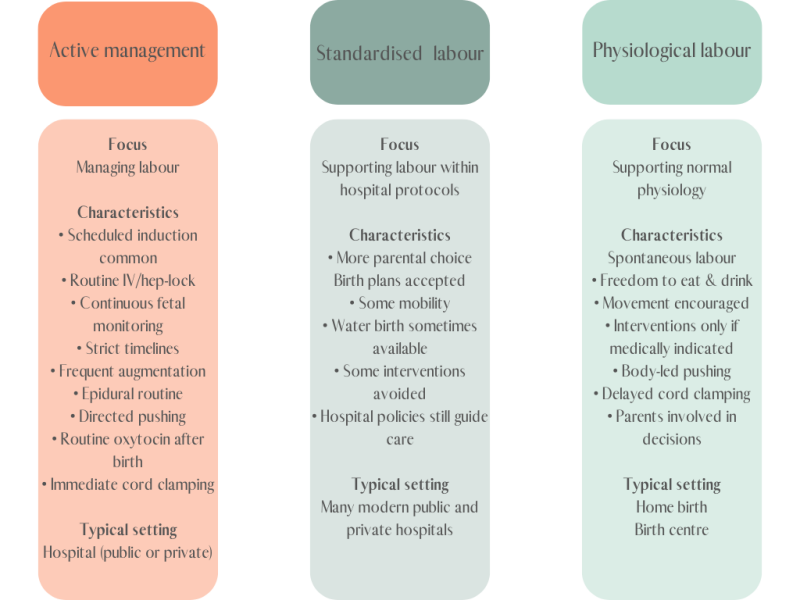
So what does this mean when you’re choosing a hospital? It means two hospitals can both call themselves “supportive of natural birth” while offering very different care in practice. That’s why looking past marketing claims, and asking specific questions about interventions, birth policies and informed choice, matters so much.
What is giving birth in a public hospital in Spain really like?
Public hospitals in Spain are often seen as the safest option, largely because they have the greatest resources, specialist teams and advanced technology for complex pregnancies, serious emergencies and life-threatening complications. For many families, that’s reason enough to choose public care.
At the same time, emergency medicine and physiological birth are not the same thing. Maternity care in the public system across Spain has made real efforts to move towards more respectful birth care, and that’s a genuine improvement. Private care, as covered earlier, has been moving in the opposite direction, towards more management and more intervention, not less. Even within public hospitals, though, many policies are still shaped more by tradition, logistics and risk management than by the strongest available evidence, and patient autonomy and informed consent aren’t always respected in practice.[5][6]
Part of this comes down to sheer volume. Spain’s public healthcare system carries a heavy caseload, doctors and nurses are working with high daily patient numbers, and that pressure shows up as longer waiting times for appointments and treatment. Layer on top of that a cultural dynamic where the doctor is placed on something of a pedestal and the patient isn’t necessarily expected to take part in deciding on treatment, and care can end up feeling rushed and blunt. You get told what to do, and the expectation is that you listen and go along with it.
Set that against private care, which tends to run on a more hospitality-driven model: staff with a customer-service mindset, more accommodation of your choice of specialist, shorter waits, hotel-style rooms, and often multi-language support for expats. On the surface, the choice looks easy.
What that comparison leaves out is exactly what we covered earlier: the higher rate of induction, instrumental delivery and C-section that tends to come with private care. A smoother check-in experience doesn’t tell you anything about how your labour will actually be managed once you’re in it.
It’s also worth noticing that the underlying culture doesn’t actually change between the two. In private care, the doctor still decides on your treatment because he’s the specialist, there isn’t more patient involvement in the medical decision-making than in public care. What looks like more choice is really choice over practical things: appointment timing, which doctor you see, being able to order a specific medical intervention, a C-section on demand rather than on medical necessity. That’s arguably part of what explains the higher intervention rates in private hospitals: induction and C-section aren’t always responses to how labour is actually progressing, it seems like they can be ordered the way you’d pick something off a menu.
I experienced the public side of this myself. When I miscarried and needed a curettage in a public hospital, nobody introduced themselves. Nobody explained what was happening, how long it would take, or what to expect afterwards. Staff barked instructions rather than spoke to me as a person.
That doesn’t mean every public hospital is like this. In fact, I know a few women who went to that same public hospital and had a great experience giving birth there. But it reminded me that respectful care isn’t created by policy alone. It depends on the people carrying it out, the culture they work in, and whether physiological birth is genuinely understood and supported, not just written into a policy document.
One practical thing to plan around: after an uncomplicated vaginal birth, Spanish public hospitals typically discharge you around 48 hours later, sooner in some regions, later after a C-section or any complication. If you’re coming from a country with longer routine hospital stays, that turnaround can catch you off guard. In the Netherlands, for comparison, it’s even faster, often just 2 to 4 hours after an uncomplicated birth, but new parents there are also entitled to kraamzorg, home-based postpartum nursing care in the days after. Spain doesn’t have an equivalent built into the public system. Dutch-trained maternity nurses and postpartum doulas do work in some areas of Spain, but that support is out of pocket, so it’s worth arranging help at home in advance, whether that’s a partner taking time off, a postpartum doula, or family flying in
How to choose the right hospital for birth in Spain: Questions to ask
Whether you’re considering a public or private hospital, don’t just compare facilities, compare philosophies of care. Here are some questions worth asking before deciding where to give birth:
-
What is your induction rate?
-
Do you let healthy women carry out pregnancy over 41 weeks?
-
What is your C-section rate?
-
Is my partner allowed in when I have to have a C-section?
-
How often do you perform instrumental births?
-
How often do you perform episiotomies?
-
Will you definitely attend my birth yourself? If not, who will?
-
Under what circumstances do you recommend induction?
-
Can I eat and drink during labour?
-
Can I wear my own clothes, or will I be expected to wear a hospital gown?
-
Is an IV or hep-lock routine? Can I decline it if there’s no medical indication?
-
Can I move freely during labour?
-
Is intermittent fetal monitoring available for a low-risk pregnancy?
-
Can I use water for pain relief, or give birth in water?
-
How many rooms with (birth) bath do you have available? If available in the hospital; Do you also have the required staff for that?
-
Can I bring both my partner and a doula, birth companion or translator? If not, why?
-
Will someone review my birth plan with me before labour, and when? (Discussing it for the first time at 38 weeks, or during labour, isn’t ideal.)
-
How do you handle it when parents decline a recommended intervention?
-
What happens if my labour progresses more slowly than expected?
Choosing where to give birth isn't really about choosing a building. It's about choosing the philosophy of care that will surround you during one of the most important days of your life.
Which birth setting is right for you?
I don’t believe there’s one “best” place to give birth in Spain, or anywhere else. There’s only the place that best matches your priorities, philosophy of birth, your health level and the health level of your baby.
If your priority is a private room, hotel-style amenities, better food, overnight accommodation for your partner and extra comfort after birth, private care may be exactly what you’re looking for. Some hospitals also let you pay extra to increase the odds that your own obstetrician or midwife attends your birth.
If you feel safest knowing that, should a rare emergency arise, you’re already in a hospital with immediate access to operating theatres, specialist doctors, blood products and neonatal intensive care, a public hospital may give you the most peace of mind.
If your priority is giving birth with the fewest routine interventions possible while still having a qualified professional present, a planned home birth with a qualified midwife is a safe option for healthy women with uncomplicated pregnancies, in a well-integrated healthcare system. This also has the highest degree of contiued care by the healthcare providers you choose, namely your team of homebirth midwives.
Home birth doesn’t mean rejecting medical care, it means starting in a different setting while keeping access to hospital care if a transfer becomes necessary. Most transfers from home aren’t urgent, and in the rare event of a serious emergency, transfers can also happen between hospitals when a private hospital doesn’t have the specialist resources needed.
Ultimately, the question isn’t whether public, private or home birth is “best.” The better question is: which model of care best supports the kind of birth you hope to have?
If your priority is supporting physiological birth while still having access to medical care when it’s genuinely needed, you’ll need to look past whether a hospital is public or private. In some regions across Spain there also is the possibilty of a standalone birth centre, which might be an option for you if you don´t want to give birrth at home. A planned home birth with a qualified midwife may be another option, but so might a hospital with a genuinely low-intervention philosophy. The model of care, the intervention rates, the hospital culture and the willingness to respect informed choice matter far more than the name on the building.
Choosing where to give birth isn’t really about choosing a building. It’s about choosing the philosophy of care that will surround you on one of the most important days of your life. I hope this helps you see those differences clearly, so that whatever you decide is truly your own.
Order your free download of the Birth Plan Pack for Spain
Wherever you choose to give birth, preparation matters. That’s exactly why I created my Birth Plan Pack for Spain. It includes a full birth preference sheet, a detailed choice list so you know what you can ask for, English and Spanish versions to share with your care team, a letter to your healthcare provider, and an eBook on writing a birth plan that starts real conversations instead of just ticking boxes on a standard hospital form.
If you want to go a step further than a downloadable pack, that’s exactly what a Birth Plan Meeting is for: sitting down together and working through your specific case; what is important for you, what questions do you have, what topics you need answers to or more information about before you make a choice, where to find reliable information, how to prioritise and how to put them into words your care team will actually engage with, rather than a form they skim and file.
Frequently asked questions
| Feature | Public Hospital | Private Hospital | Planned Home Birth |
|---|---|---|---|
| Cost | No cost at point of care (publicly funded) | €6,000-10,000+ self-pay, or covered by insurance | €1,300-3,000+ (up to €5,000 depending on inclusions), self-pay |
| Emergency care | Immediate | Immediate for most emergencies; transfer may be needed for highly specialised care | Transfer if needed |
| Midwife-led care | Often | Less common | Yes |
| Intervention rates | Lower | Higher | Lowest |
| Private room | Sometimes | Usually | Your own home |
| Partner overnight | Rarely | Often | Yes |
| Best suited for | Complex pregnancies, those wanting immediate specialist resources | Parents prioritising comfort, amenities and continuity (where available) | Healthy women with uncomplicated pregnancies seeking physiological birth with qualified midwifery care |
Want to delve into the material yourself? Good idea! Here are my sources
-
Ministerio de Sanidad (2024). Informe SNS 2023 — C-section rates, public vs private (2022 data). Via Infobae: https://www.infobae.com/america/agencias/2024/08/05/la-tasa-de-cesareas-en-la-sanidad-publica-fue-del-224-en-2022-mientras-que-la-registrada-en-la-privada-fue-del-345/
-
World Health Organization (1985/2015). WHO Statement on Caesarean Section Rates. https://www.who.int/publications/i/item/WHO-RHR-15.02
-
Hernández-Martínez, A., Martínez-Galiano, J.M., Rodríguez-Almagro, J., Delgado-Rodríguez, M., Gómez-Salgado, J. (2019). Evidence-based Birth Attendance in Spain: Private versus Public Centers. Int J Environ Res Public Health, 16(5), 894. https://pmc.ncbi.nlm.nih.gov/articles/PMC6427791/
-
International Journal of Nursing Studies (2022). Study on intervention rates by parity and birth setting in Spain. https://www.sciencedirect.com/science/article/pii/S0020748921002741?via%3Dihub
-
Obstetric Violence in Spain (Part I): Women’s Perception and Interterritorial Differences. Int J Environ Res Public Health, 17(21), 7726 (2020). https://pmc.ncbi.nlm.nih.gov/articles/PMC7660046/
-
Obstetric Violence in Spain (Part II): Interventionism and Medicalization. https://pmc.ncbi.nlm.nih.gov/articles/PMC7794951/
-
García-Lorca, A.I. et al. (2019). Episiotomy rate at the Arrixaca University Clinical Hospital and factors that influence the practice. Rev Esp Salud Pública, 93. https://valdecasasycols.es/en/blog/obstetrics/episiotomia
-
SEGO (2006). La episiotomía en España. Datos del año 2006. Progresos de Obstetricia y Ginecología. https://www.sciencedirect.com/science/article/abs/pii/S030450130872329X
-
Escuriet, R. et al. (2015). Cross-sectional study comparing public and private hospitals in Catalonia: Is the practice of routine episiotomy changing? BMC Health Services Research. https://bmchealthservres.biomedcentral.com/articles/10.1186/s12913-015-0753-z
-
Ministerio de Sanidad (2021). Atención perinatal en España: Análisis de los recursos físicos, humanos, actividad y calidad de los servicios hospitalarios, 2010-2018. https://www.sanidad.gob.es/va/estadEstudios/estadisticas/docs/Informe_Atencion_Perinatal_2010-2018.pdf
-
Recio Alcaide, M. et al. (2021). An impact evaluation of the strategy for normal birth care on caesarean section rates and perinatal mortality in Spain. Health Policy. https://doi.org/10.1016/j.healthpol.2021.11.003
-
Elsevier (2010). Delivery breakdown in Spain (non-instrumental, instrumental, caesarean). https://www.elsevier.es/index.php?p=revista&pRevista=pdf-simple&pii=S0304501310001858&r=151
-
Impact of Midwifery-led units in Spain: lessons from the first years (2024, preprint). https://www.medrxiv.org/content/10.1101/2024.07.16.24310479v1.full.pdf
-
Ministry of Health. Strategy for Assistance at Normal Childbirth (EAPN), approved 2007. https://www.sanidad.gob.es/areas/calidadAsistencial/estrategias/atencionPartoNormal/home.htm
-
Póliza Médica (2026). Private birth costs and maternity insurance premiums in Spain. https://www.polizamedica.es/seguros/salud/seguros-medicos-para-embarazadas
-
Avanti Travel Insurance (2026). GHIC/EHIC coverage guide, planned births excluded. https://www.avantitravelinsurance.co.uk/what-is-ghic-ehic-card
-
SpainExpat. Pregnant in Spain — insurance, visas and coverage by residency situation. https://spainexpat.com/information/pregnant-in-spain
-
Euro Weekly News (2025). A guide to natural birth options in Spain — home birth cost range. https://euroweeklynews.com/2025/08/31/a-guide-to-natural-birth-options-in-spain/
-
Marina Matrona. Home birth pricing structure, including travel costs for midwives based over 100km away. https://marinamatrona.com/precio-de-parto-en-casa/
-
Tarinas Viladrich Bufete (2020). Derecho a la libre elección de médico.
https://tarinas.com/derecho-a-la-libre-eleccion-de-medico/
These pregnancy, birth and postpartum blog stories you might also like:
Add comment
Comments