

Are you preparing for birth and wondering what to do with your body when the moment arrives? Most women picture lying on their back in a hospital bed — but that's actually one of the least effective positions for birth. Moving freely and choosing positions that work with your body and your baby can make a huge difference to how your labour progresses.
Here are six birth positions worth knowing before your birth day:
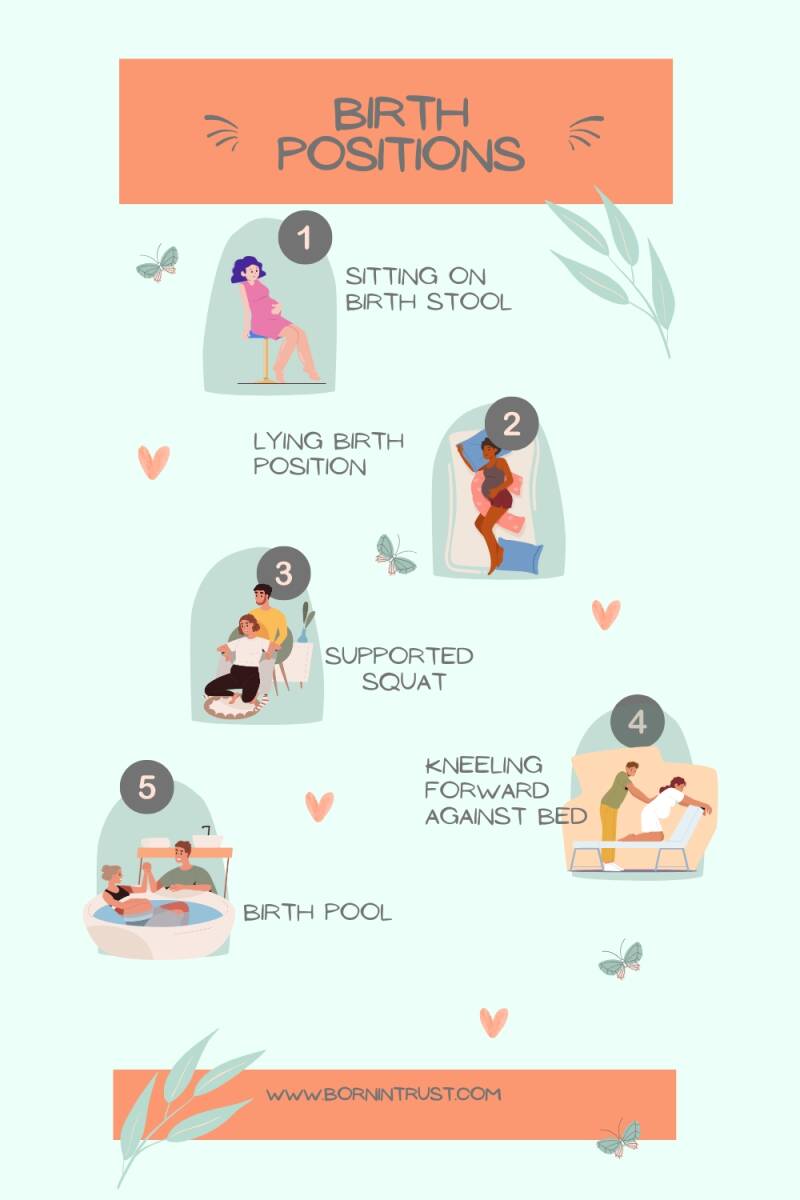
Sitting on a birth stool
Supported by your birth partner, this position helps relax the pelvic area. Because it resembles sitting on a toilet, it triggers a natural conditioned release — your body already knows what to do in this position. Another advantage is that gravity works with you and your baby. This was for me the preferred position during 2 of my births, because during the surge I could get up and stand. In between I would sit back down again. Didn´t think about it, but it felt very good. Instinctively you will know what to do if given (or taken) the freedom to move.
Lying on your side to birth
In this position, you lie on your side with your upper leg lifted and supported by your birth partner. It's a comfortable position to move through surges, and it encourages opening by giving your baby more space to navigate the birth canal.
When your knee is higher than your ankle, your pelvis opens more from the top — making this position particularly helpful during the earlier phase when you're still opening and thinning (dilating and effacing). That said, the most important thing is always how a position feels for you in that moment.
It's worth sharing this with your birth partner too, so they can gently suggest it and experiment together with you to find what feels most comfortable.
Supported birth squat
Like the birth stool, this position relaxes the pelvic area and appeals to the same natural release reflex. Here too you have gravity working with you and your baby. You can lean back against your birth partner for support. A beautiful bonus: your partner can hold you, kiss your forehead and whisper encouraging words in your ear while you breathe your baby down.
The caregiver also has a good view from this position when they kneel down, making it easier to monitor progress and support the birth of your baby's head. Assuming you want your care provider to be involved at this level. You can also choose to have a hands (and eyes) off delivery, just not in most hospitals.
From here it's easy to transition into an all fours position, where you are kneeling forward and resting on your hands and knees. This is a natural flow between two powerful birth positions.
Do keep in mind that this position requires quite some strength in your legs. It's anyway good to be fit for birth. Some positions simply ask more of your body than others. If this one doesn't feel right on the day, trust yourself and move to what does.
Kneeling Birth Position - forward against a bed or chair
Lean forward and rest your upper body against a bed, chair, or birth ball. This position can help your baby turn and align properly, encouraging labour to progress.
If you're experiencing back pain, this position makes it easy for your birth partner to apply counter-pressure to your lower back, which many women find enormously relieving. There are some sweet spots that can help enormously — and when your partner knows exactly where to find them, it can make a world of difference. In the full HypnoBirthing course we cover this in depth, so you and your birth partner arrive on the day fully prepared.
In the Birth Pool
Water makes movement effortless. In a birth pool you can explore all kinds of positions far more easily than on land. Try different positions and see what feels right. Aim to change position roughly every 30 minutes to keep things moving. Some positions that work beautifully in the pool: reclined on your back, all fours, kneeling in a frog position, or hanging over the rim. Let the water guide you.
A less talked about advantage of the birth pool is that it creates a natural boundary between you and your caregivers. If you prefer minimal intervention and don't want your midwife too close, the pool makes it more effort for anyone to reach you, not impossible, but enough to give you more space and autonomy during your birth.
A few things to remember when preparing for birth
There is no single "correct" position. Every woman and every birth is different. Keep moving during labour. Staying in one position for too long can slow progress. Your birth partner is a key part of this, practise these positions together before your birth day so they feel natural when the moment arrives.
In a Spanish hospital, you may need to advocate for your right to move freely. Put your preference for freedom of movement in your birth plan and discuss it with your caregiver before you go in. That way you'll know in advance whether they are willing to work with you on what matters to you. And if they're not? You can always change caregiver — if it's important to you, it's worth it.
Want to practise these positions and learn exactly how to use them during labour? This is one of the many things we cover in the HypnoBirthing courses at Born in Trust, in Málaga and online across Spain.
These pregnancy, birth and postpartum blog stories you might also like:



Add comment
Comments